URXR One: 93-Gram Spatial Display Glasses for Real Work
Wearable computing has mostly split two ways: full mixed reality headsets with real spatial capability and real weight, or lightweight video glasses that act as a floating monitor and little else. The URXR One, from Mountain View startup Unseen Reality, tries to collapse that gap into a frame weighing 93 grams.
What the URXR One Actually Is
This is not a standalone headset. There is no onboard operating system, no battery and no app store. It connects over USB-C using DisplayPort Alt Mode to a device you already own, whether a MacBook, a Windows laptop, a desktop PC, a phone or a handheld console, and turns that output into one or more large virtual screens around you.
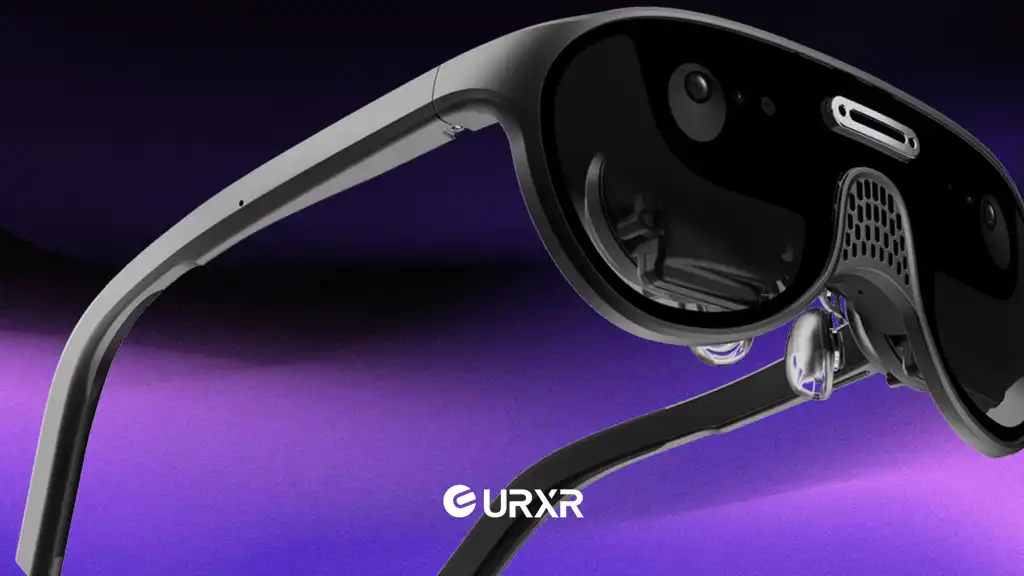
What sets it apart from conventional display glasses is what sits behind the lenses: pancake optics, high-resolution micro-OLED panels, full-color video pass through, 6DoF positional tracking and hand tracking. That list normally belongs to devices several times the size.
Display and Optics
Resolution and Sharpness
Each eye gets a 1.03-inch micro-OLED panel running 2448 x 2064 pixels at 90 Hz, an estimated 36 pixels per degree. That is a clear step up from the roughly 1920 x 1200 panels in current XREAL and Viture glasses. Text renders more cleanly and the shimmering that plagues fine detail on full HD video glasses is largely gone. Colours are vivid, blacks are deep, and shadow detail survives.
Pancake Lenses and IPD Adjustment
The optical stack uses pancake lenses rather than the birdbath design common in this category. The tradeoff is brightness, since pancake systems pass less light, but edge-to-edge clarity is strong and colour shift toward the lens edges is minimal. Some glare appears in high-contrast scenes, which is essentially unavoidable with this design.
Unusually for glasses this small, the URXR One offers mechanical IPD adjustment for each eye across a 58 to 68 mm range rather than a fixed optical centre.
A Field of View Built for Virtual Monitors
Field of view has been the persistent compromise of display glasses, and it is the headline change here. The URXR One advertises 90 degrees diagonal, roughly 80 degrees horizontal and 57 degrees vertical. For context, the XREAL Aura is quoted around 70 degrees, and most current video glasses sit closer to 57.
The shape matters as much as the size. The visible area lands near a 16:9 ratio, which maps naturally onto virtual monitors, and the extra horizontal room means fewer moments where screen edges get clipped as you turn your head. Binocular overlap of roughly 75 percent helps reduce eye strain over long sessions.
Video Pass Through Under 10 Milliseconds
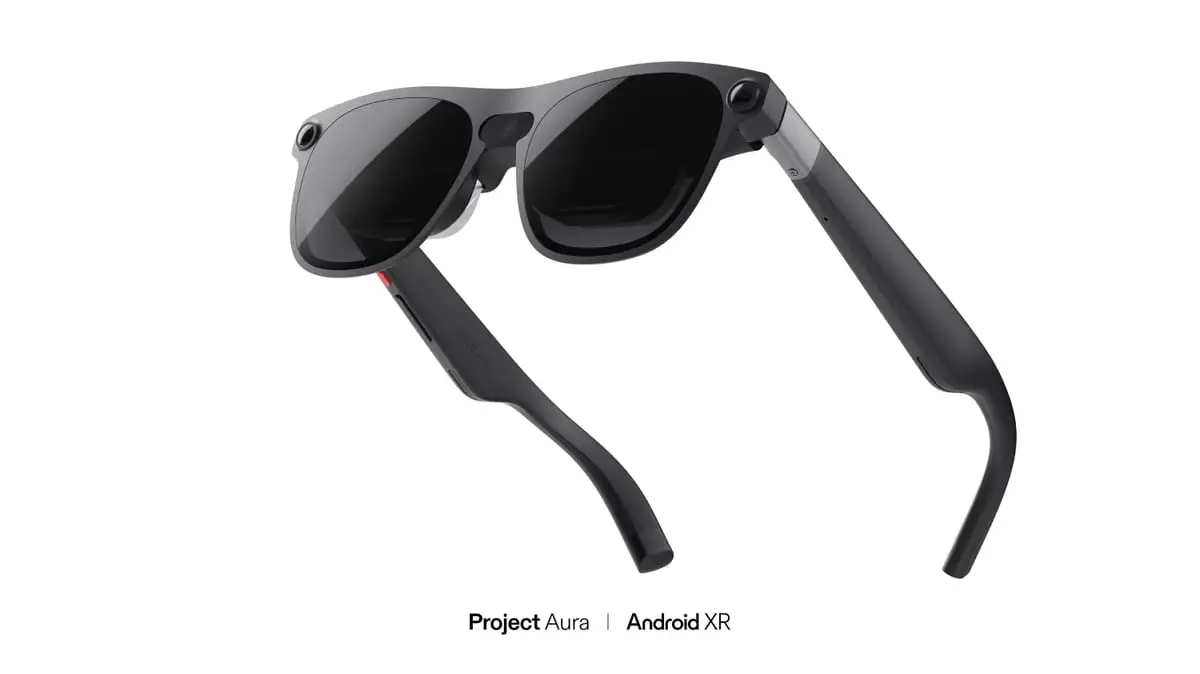
The glasses carry two SLAM cameras for tracking, two colour cameras for pass through and an ambient light sensor. Unseen Reality rates pass through latency at under 10 milliseconds, lower than the figure quoted for the Apple Vision Pro. The ambient light sensor matches pass through colour and brightness to the real room, so the camera image blends into the peripheral vision you still have around the frames. Because the panels generate heat, the glasses include active cooling with a quiet, constant fan.
Comfort and Wearability
At 93 grams with no onboard battery, the URXR One sits in a different comfort category from the Vision Pro, Quest 3 or Samsung Galaxy XR. A larger, bendable nose pad spreads the load better than the thin pads typical of video glasses, and multi-hour sessions are reported without the facial pressure a head strap creates. They are also discreet enough for a train, a plane or a co-working space.
Audio
There are no speakers. Users bring their own earbuds, which saves weight and cost. Microphones capable of spatial audio recording are included.
Spatial Computing and Multiple Screens
The device runs in two modes. Direct mode is plug and play: connect the cable and get a single large virtual screen with no software involved. Companion mode runs through the free URXR Connect app for Windows, Mac, iOS and Android, and this is where it stops being a monitor replacement.
In companion mode you can create multiple virtual displays, position them anywhere around you, resize them, adjust aspect ratio and arrange them as a familiar multi-monitor desk or scattered spatially around a room. Tracking is computed on the glasses using dual-eye SLAM and a 1000 Hz IMU, keeping latency low.
Power Requirements and Tracking
Tracking mode depends on how much power the host port supplies. Around 15 watts unlocks full 6DoF, letting you lean toward a screen or move through the workspace. Roughly 7.5 watts gives stable 3DoF, where screens stay pinned in a direction but do not respond to positional movement. Handhelds such as the Steam Deck and ROG Ally generally fall into the second category, and phones need the optional power hub accessory.
Hand Tracking
Mouse and keyboard remain fully usable, but hand tracking is available for direct interaction, including pinch to click. Pre-production hardware showed slight delay, which the company attributes to a sampling rate being raised for final units.
Virtual Environments
When pass through is not wanted, the glasses can replace the real room with a virtual environment to work inside.
Beyond Productivity
Although aimed squarely at work, the URXR One includes a media player for 2D and 3D video and a virtual cinema environment. Games from connected handhelds benefit from the micro-OLED panels and wider field of view. SteamVR and PCVR are not supported at launch.
Price and Availability
Retail price is $899, with Kickstarter pricing starting at $699 for limited early-bird tiers and $799 as the standard campaign price. Shipping is targeted for fall 2026, with mid-October cited as the internal goal.
The Team
Unseen Reality was founded by Edward Zhou, previously a display architecture developer at Apple and technical display optics lead at Meta. The company reports that engineering validation testing and the first tooling round are complete, materials were purchased in May, and two further tooling rounds are planned.
A Note on Crowdfunding
Kickstarter is not a pre-order. Every crowdfunding campaign carries delivery risk, and buyers who want certainty can wait for retail availability at $899.
The Bottom Line
The significance of the URXR One is less any single specification than what the combination allows: Vision Pro style spatial windows, running on the computer you already use, in something you can wear on a train. For anyone whose interest in XR is carrying several large monitors without carrying monitors, it is one of the more consequential devices to appear in this category.