Akira in the Browser: Cortiz Dev's Three.js Experiment
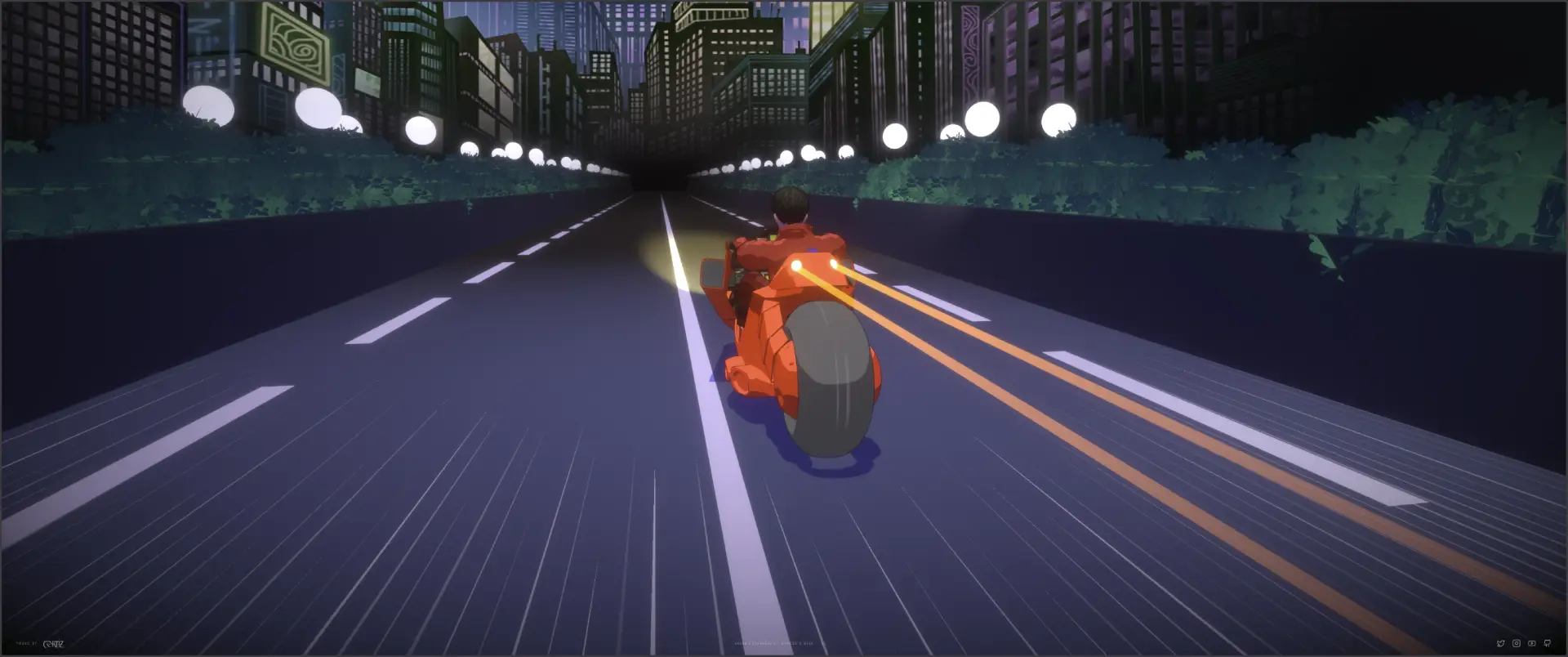
The result is a fully playable, real-time experience that captures the speed, the atmosphere, and the raw visual energy of the 1988 anime classic. That's exactly what Cortiz Dev set out to build.
The project recreates the highway chase from the opening of Akira, not as a frame-by-frame copy, but as a living, interactive diorama. Think of it as a playable mood piece: the neon-soaked city blur, the roaring motorcycle, the light trails cutting through the night. Built entirely with Three.js and React Three Fiber, it runs in any modern browser with no installation required.
The Inspiration
After rewatching Akira, Cortiz Dev found the opening bike chase impossible to shake. The stylized lighting, the graphic shadows, the sense of overwhelming speed felt like the perfect canvas for two techniques that had been on the to-do list for a while: cel shading and a VFX method known as mesh trail. The anime's iconic light streaks from the motorcycles turned out to be a natural fit for that second technique, and a concept began to take shape.
Rather than building a full game from the start, the goal was more focused: capture the feeling of that one scene. Speed, contrast, atmosphere.
How the Scene Comes Together
An Infinite Road That Never Ends
The highway stretches on forever, but it's built from just ten road segments, recycled continuously as the bike moves forward. It's a classic game development trick called object pooling: instead of generating new geometry as you ride, the segments behind the player are quietly repositioned ahead. The result feels seamless and costs almost nothing in performance.
The Anime Look
The visual style leans hard into cel shading, the technique behind the flat, graphic aesthetic of classic anime. Every surface on the bike and rider uses a custom shader that renders light in three distinct zones: highlight, base, and shadow. No smooth gradients. Just bold, defined color breaks that make the scene feel like it was pulled directly from a hand-drawn frame.
The Light Trail
The mesh trail effect is the heart of the project and the reason it exists at all. As the bike moves, a glowing tube is drawn in its wake, rebuilding itself every frame from a history of recent positions. Combined with a bloom post-processing pass, the trails glow with an intensity that immediately recalls Akira's signature energy. Activating turbo mode pushes the effect further: the bloom intensifies, the camera pulls back, and lightning bolt effects crackle across the screen.
The Rider
The character was rigged and animated using Mixamo for the base setup, then refined in Blender with custom animations: a relaxed riding pose for normal speed and a more aggressive lean for turbo mode. The cel shader ties the rider visually to the rest of the scene, making everything feel part of the same hand-drawn world.
A Work in Progress
Cortiz Dev is open about the fact that this is still evolving. The background currently uses a parallax image layer, with plans to add multiple depth layers and a detailed city lights system. The code has not been released yet, as that decision is still open. A second part covering game mechanics is also being considered.
Try It Yourself
Reading about it only goes so far. The best way to understand what Cortiz Dev has built is to experience it directly: feel the speed, trigger the turbo, watch the light trails bloom.
Play the live demo here: kaneda-bike.vercel.app